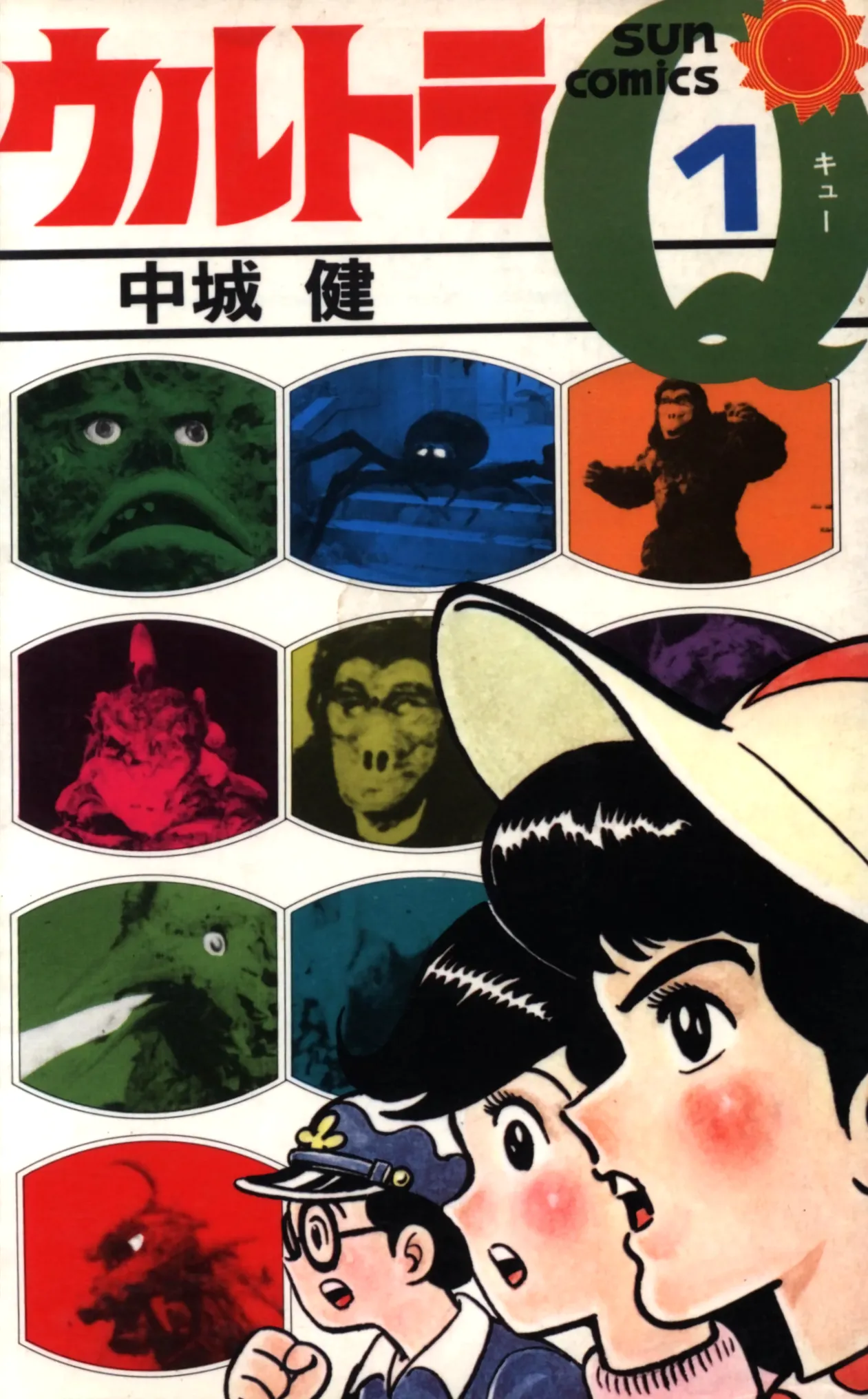
Ultra Q
Synopsis
(from fukkan.com):
**"For the next 30 Minutes, your eyes will leave your body and arrive in this strange moment in time..."**
--(From Tsuburaya Productions' "Ultra Q")
You can read the masterpiece of that imaginary tokusatsu series in manga form. Don't miss the gripping action with Jun Manjome and Yuriko Edogawa.
≪Description of the work≫.
In 1966, when the penetration rate of black-and-white televisions exceeded 90%, TBS's "Ultra Q" which began airing in January, quickly became a popular program with viewer ratings in the 30% range. Until then, the program offered free weekly encounters with Tsuburaya's monsters, which could only be seen in movie theaters during spring and summer vacations.
It was no wonder that children waited 1001 days for the Sunday night 7:00 p.m. broadcast. In the publishing world, which is sensitive to the anticipation of the times, Kodansha was the first to recognize the potential of "Ultra Q". Ten months before the TV broadcast, the company began serializing the manga in the monthly magazine "Bokura".
After the initial serialization it was subsequently ceded to a rival, Shueisha's Shonen Book took on the challenge of the first comicalization in its spring vacation extra issue a year later. The first volume, "I Saw a Bird" was drawn by Ken Nakajo, who later established his own era with a series of martial arts manga. The magazine received overwhelming support from readers, and Ken Nakajo also published his new drawings in a large-format book called "komix" at the time.
Many of the 10 chapters created by Nakajo are long stories with few page restrictions, and they can be said to be a model for TV Manga adaptations.
Volume 2
Gomez, awakened from an ancient slumber, goes on a rampage, Garamon arrives from space and destroys the city, and a money-hungry child transforms into Kanegon. This is the second installment of the TV series, with an original episode added. This is the only book where you can read the unproduced "Rose of Mars," which only has a script by Tetsuo Kinjo.
In an era before DVDs, let alone Beta or VHS recorders, stocking television programs was a pipe dream. Even if you wanted to watch it again, you had no choice but to patiently wait for a rebroadcast. The only way to relive the thrill of television and satisfy your desire to own it was through comic book adaptations. Shueisha's "Shonen Book Comics Ultra Q," which was released in 1966 in conjunction with the original broadcast, sent boys and girls enthralled with the TV monsters running to bookstores every time. Due to viewer demand, "Ultra Q" was scheduled for a rebroadcast starting the following summer. To celebrate, Shonen Book included a comic book adaptation by Takeshi Kojo as a supplement for four consecutive months. Kojo's works deliberately do not stick to the TV version, but instead pursue original stories using familiar monsters. The rebroadcasts were well-received, and by November, halfway through, a new comic book adaptation began publication in "TBS Comics," a magazine launched by Umeda Produce Center. Artist Joji Kido is a talented artist who has been active in the world of rental comics since the age of 15. All five comic adaptations are short but highly acclaimed, and in particular "Rose of Mars," published in the January 1968 special issue, is a phantom work for which Kinjo Tetsuo wrote the script but which was never produced due to various circumstances.
[Additional Info](http://blog.livedoor.jp/godzitoraman/archives/1002414.html)
Authors
Artists
Original Publisher
Serialized in (magazine)
Chapters
Volumes
Publication Year
Status
Type
Demographic
Genres
Themes
Format
Alternative Titles
 ウルトラQUrutora KyūUrutora Q